
Computer Science Student Research
AI & ML | Computing & Society | VR, XR, HCI, HRI, & Accessibility | Software Engineering | IoT | Bioinformatics | Theory | CS Education
Computer Science is a large tent covering everything from theoretical foundations to applied systems. At Bucknell, our talented Computer Science students follow a rigorous core curriculum, and also have the opportunity to take courses and work with faculty on high-impact research and applied projects in a variety of different subfields. Student opportunities are available for credit or pay, and include numerous academic year projects and funded summer positions. Former student researchers go on to sought-after positions in industry and elite graduate programs.
Some active research areas are outlined below with relevant courses and selected examples of recent faculty and student research projects. Bucknell students’ names are highlighted.
You may also be interested in visiting our archives of summer research and senior design projects.
Artificial Intelligence (AI) and Machine Learning (ML)
This area focuses on creating intelligent systems that can learn from data, make predictions, and perform tasks that typically require human intelligence. Faculty research in this area explores foundational AI/ML algorithms and their innovative applications across diverse fields, from healthcare to robotics and beyond, aiming to solve complex real-world problems.
Selected Courses
CSCI 349: Applied Machine Learning
In this hands-on course, students study the full data science pipeline—from data preparation to model development and visualization—using industry-standard Python tools. The course emphasizes supervised learning, foundational unsupervised methods, ethical considerations and responsible AI. Students build practical machine learning skills to solve real-world challenges.
CSCI 357: Artificial Intelligence with Neural Nets
This hands-on advanced elective explores the rise of modern Artificial Intelligence through the evolution of artificial neural network architectures. The course begins with a concise historical perspective, moving from the single-layer perceptron and multi-layer architectures with backpropagation to recurrent structures and reservoir computing models for time series and sequential data. Students then explore modern innovations in AI with deep learning models, attention mechanisms, and the transformer-based large language models that power today’s state-of-the-art AI systems.
CSCI 365: Image Processing and Analysis
This course covers the acquisition, processing and analysis of digital images. Students learn about the human visual system and study how neutral networks and machine learning can be used in pattern recognition and automatic image understanding and classification. They also study image processing techniques for image and video enhancement, restoration, and compression.
CSCI 379: Biometrics
Biometrics is the science of recognizing individuals by using their physical (e.g., fingerprints, faces, irises) or behavioral (e.g., gait, swiping, typing, signatures) traits. This course will discuss several of these traits and the automated techniques used for feature extraction, matching, and performance evaluation. In addition, students study possible attacks and countermeasures for these biometric systems, known biases, and privacy concerns arising from unauthorized access to individuals’ biometric data.
CSCI 379: AWS Cloud Technologies
In this weekly seminar, students explore AWS cloud technologies through hands-on projects. Students select from multiple tracks including (but not limited to) cloud foundations, machine learning, data engineering, security, or web development based on interests and career goals. The course emphasizes practical experience with industry-standard cloud services, utilizing AWS Academy which provides certification exam discounts for students interested in continuing beyond the class.
Selected Student and Faculty Research
Zi Wang ’27 and Rajesh Kumar. Evaluating Smartwatch-Based Gait Authentication Under Dictionary Attacks. In Proceedings of IEEE International Joint Conference on Biometrics. 2026
Duy Le ’27 and Joshua V. Stough. Tiger-SIREN: Anatomy-Aware Cross-Organ Lesion Synthesis for Breast Ultrasound without Tumour Labels. Proceedings of SPIE Medical Imaging 2026: Ultrasonic Imaging and Tomography, 1393114, 2026.
Naing Lwin ’26 and Rajesh Kumar. Deterministic vs. LLM-Controlled Orchestration for COBOL-to-Python Modernization (Honorable Mention Paper Award). ACM AIware 2026.
Aditya Sharma, Vinti Agarwal, and Rajesh Kumar. G-Loss: Graph-Guided Fine-Tuning of Language Models. (the Best Poster Critics’ Choice Award). In Proceedings of the Learning on Graphs conference. 2025
Taehwan Kim ’20 and Brian R. King. Time series prediction using deep echo state networks. Neural Computing & Applications 32, 17769–17787, 2020.
Computing and Society
Teaching and research in this area is concerned with the societal and ethical implications of computing, including privacy, fairness, justice, and bias in machine learning and other automated systems.
Selected Courses
CSCI 279: Data and Justice
In this project-based course, students will learn how to develop data analysis questions relevant to justice and injustice in our world, and learn the fundamentals of data analysis using the Python pandas library. This course will help students gain data analysis skills, understand (the often human) sources of data, and develop as sophisticated thinkers, sharpening their technical skills as well their ability to understand underlying social and historical forces that shape data.
CSCI 345: Computers and Society
In this course, students analyze the impact of computing on society through the application of deontological and consequence-based ethical theories and professional codes of ethics. Students will learn to analyze the impacts of computing on the fundamental values of society so as to be able to create systems that don’t oppose social progress.
Selected Student and Faculty Research
Swarup Dhar ’22, Vanessa Massaro, Darakhshan Mir, and Nathan Ryan. Uncertainty in criminal justice algorithms: Simulation studies of the Pennsylvania Additive Classification Tool. In Mathematical and Computational Methods for Complex Social Systems, American Mathematical Society, 2025.
Christina N. Harrington, Aashaka Desai, Aaleyah Lewis, Sanika Moharana, Anne Spencer Ross, and Jennifer Mankoff. Working at the Intersection of Race, Disability, and Accessibility. ACM SIGACCESS Conference on Computers and Accessibility, 2023.
Virtual Reality (VR), eXtended Reality (XR), Human Computer Interaction (HCI), Human Robot Interaction (HRI), and Accessibility
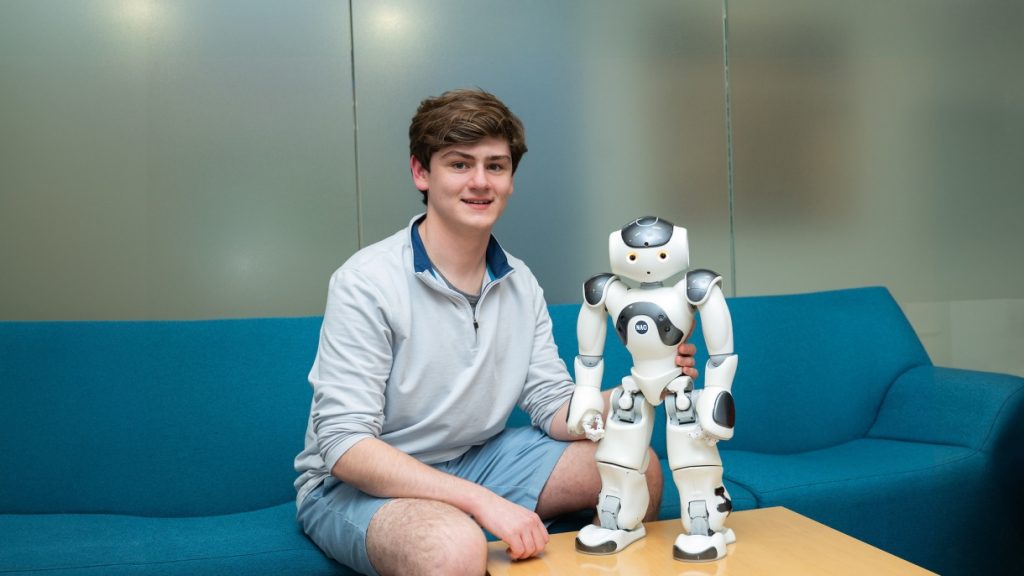
Our interaction with computing technology is evolving quickly, from laptops to cellphones to (potentially) a future of ambient computing. This active research theme centers on designing and evaluating new ways for humans to interact with digital information, computers, and robots. It includes creating immersive virtual and augmented reality experiences, developing intuitive user interfaces, and ensuring that technology is accessible and usable by people of all abilities. The goal is generally to make technology more natural and inclusive while empowering the human in the loop.
Selected Courses
CSCI 279: Digital Accessibility
This course covers best practices in making technology accessible to people with disabilities. We’ll explore first-person and historic narratives; human, business, and legal motivations; assistive technologies; web accessibility standards; and learn soldering to help a local school district adapt toys.
CSCI 358: Human Computer Interaction
In this interdisciplinary course, students study research at the intersection of people and computing. Through a variety of prototypes (3-D user interfaces, visual design, data communication, intelligent user interfaces, etc.), students deliberately practice processes that result in useful, usable and maybe even inspirational computer interfaces.
CSCI 379: Design and Development for XR
This course introduces students to the design and development of applications for Extended Reality (XR), with a strong focus on Virtual Reality (VR) and Mixed Reality (MR). Using Unity as the primary development platform, students will explore hands-on the fundamental principles of XR interaction, spatial computing, and immersive user experience (UX) design with Meta Quest 3 headsets. By the end of the course, students will have developed their own interactive XR applications, gaining both technical proficiency in Unity and a deep understanding of how to craft compelling and user-friendly experiences in VR and MR.
CSCI 379: Interactive Computer Graphics
This programming-oriented course introduces students to the computational and mathematical foundations of computer graphics using WebGPU. Students learn how interactive visual content is created through topics such as geometric modeling, transformations, shading and lighting, texture mapping, animation, scene graphs, and user interaction, while implementing these techniques directly rather than relying on game engines. Through hands-on programming assignments and a final specialization project in areas such as interactive graphics, animation, rendering, or game development, students develop foundational skills relevant to Virtual Reality (VR), Extended Reality (XR), Human-Computer Interaction (HCI), and other interactive computing applications.
Selected Student and Faculty Research
Yasmine N. Elglaly, Catherine M. Baker, Anne Spencer Ross, and Kristen Shinohara. Beyond HCI: The Need for Accessibility Across the CS Curriculum. In Proceedings of the 55th ACM Technical Symposium on Computer Science Education, 324–330, 2024.
Sean O’Connor ’26 and L. Felipe Perrone. Collaborative and Reproducible HRI Research Through a Web-Based Wizard-Of-Oz Platform. In Proceedings of the 2025 34th IEEE International Conference on Robot and Human Interactive Communication (RO-MAN), Eindhoven, Netherlands, 2025.
Ben Khant ’27 and Sing Chun Lee. Developing an In-House Augmented Reality Optical-See-Through Head-Mounted Display for Computing Education. In Proceedings of the 57th ACM Technical Symposium on Computer Science Education, 1395–1396, 2026.
Ayano Nozawa ’27, Lea Wittie, and Sing Chun Lee. Balancing Immersion and Usability: Student Perspectives on XR and 2D Interfaces for Parse Tree Constructions. In Proceedings of the 2026 ASEE Annual Conference. 2026.
Software Engineering and Web Development
Software engineering is the application of engineering principles and techniques to the design, development, testing, and maintenance of large software systems. All computer science majors engage in multiple group software engineering projects in multiple programming languages, and using standard collaboration tools and techniques like Git and scrum.
Selected Courses
CSCI 205: Software Engineering and Design
This core course teaches students the fundamentals of software design and software engineering. Students participate in a large-scale, team-based software development project.
CSCI 379: Full Stack Web Development
This elective course offers students an opportunity to learn functional programming principles using the Elixir programming language. Additionally, it provides an in-depth exploration of state of the art web development, both on the frontend and backend, using the Phoenix MVC framework and TailwindCSS. Students will also learn to effectively use LLM and AI to assist with code generation. Skills learned are transferable to other tech stacks like React, NodeJS and other MVC frameworks.
CSCI 475/6: Senior Design
In their senior year culminating experience, groups of computer science majors undertake a major software engineering project for a client. Over the course of the year, they are responsible for several cycles of delivery, each including a design document, product implementation, testing, and feedback. The final product is accompanied by detailed technical and user manuals, and is shared in a public presentation of the design process.
Internet of Things (IoT) and Embedded Computing
This research area explores the expanding network of interconnected physical devices, vehicles, buildings, and other items embedded with sensors, software, and connectivity. The focus is on designing and developing novel hardware and software for these embedded systems, enabling seamless communication and intelligent automation in everyday environments.
Selected Courses
CSCI 306: Computer Systems
This core course covers fundamental concepts showcasing the integration of hardware and software. Topics include data representation, processor architecture, memory, and I/O. Students engage in Unix system programming in C and assembly language.
CSCI 320: Computer Architecture
In this course, students primarily explore two important topics in computer architecture: the memory hierarchy and parallelism in all its forms. Students use a hardware description language to implement concepts including pipelining, cache and branch prediction.
CSCI 332: The Internet of Things
This course is a broad investigation into the design of internet-connected physical objects and the infrastructure that supports them. This hands-on course covers topics including embedded systems, wireless communication, internet protocols, cloud computing and security. Students will develop their own IoT system.
Selected Student and Faculty Research
Ryan Koes ’26. A Machine Learning-Enhanced Electronic Tongue for the Unbiased Characterization of Coffee.
Tsugunobu Miyake ’25 and Alan Marchiori. A Continuous Turbidity Meter with Synchronous Detection. In Proceedings of the 2024 IEEE Applied Sensing Conference, Goa, India, 2024.
William Jackson ’24, Alan Marchiori, Stewart J. Thomas, Elizabeth Capaldi and Sean Reese. Verifying IMU Suitability for Recognition of Freshwater Mussel Behaviors. In Proceedings of the 2023 IEEE International Symposium on Inertial Sensors & Systems (INERTIAL), 2023.
Bioinformatics
Bioinformatics is the computational analysis of DNA, RNA, and protein sequences to identify patterns involved in genetics, disease, or phylogeny.
Selected Student and Faculty Research
Jessen Havill, Olivia Strasburg, Tessy Udoh, Jacob E. Crawford, and Andrea Gloria-Soria. EVE-X: Software to Identify Novel Viral Insertions in Wild-Caught Arthropod Hosts from Next-Generation Short Read Data. Molecular Ecology Resources 25(e14026), 2025.
Alexander Murph, Abby Flynt, and Brian R. King. Comparing finite sequences of discrete events with non-uniform time intervals. Sequential Analysis, 40(3), 291–313, 2021.
Theoretical Foundations
This area delves into the fundamental mathematical and logical underpinnings of computer science. Research here explores the limits of computation, the efficiency of algorithms, and the formal methods that ensure software and hardware systems are reliable and secure. These theoretical insights drive innovation and efficiency across all areas of computing.
Selected Courses
CSCI 311: Algorithm Design & Analysis
This course is an introduction to standard patterns and techniques in algorithm design and tools for analyzing algorithmic performance. Students learn to evaluate algorithms, design new algorithmic solutions, and communicate the correctness and usefulness of their solutions.
CSCI 341: Theory of Computation
In this course, students study theoretical models of computation and their limits to better understand what computers can and cannot do.
CSCI 351: Distributed Computing
This course is an introduction to concurrency, communication, and fault-tolerance in distributed computer systems. Students learn fundamental models of distributed computing and use them to study classic problems and their solutions or impossibility. Examples include consensus, mutual exclusion, distributed data structures and more. We focus primarily on theoretical results, also applying them in practical implementations.
Selected Student and Faculty Research
Samuel Baldwin ’24, Cole Hausman ’24, Mohamed Bakr ’23, and Edward Talmage. Relaxation for Efficient Asynchronous Queues. 32nd International Colloquium on Structural Information and Communication Complexity (SIROCCO), 2025.
Liam Moyer ’24, Jameson Railey ’23, Andrew Daw, and Samuel C. Gutekunst. Scorigami: Simulating the Distribution and Assessing the Rarity of National Football League Scores. In Proceedings of the Winter Simulation Conference, 2024.
Samuel C. Gutekunst, Billy Jin, and David P. Williamson. The Two-Stripe Symmetric Circulant TSP is in P. Mathematical Programming, 2025
Todd Schmid. Coalgebraic Path Constraints. In Proceedings of the 18th International Workshop on Coalgebraic Methods in Computer Science, 2026.
Computer Science Education
This is the study of how people teach and learn computer science. Faculty in our department have contributed in multiple ways to this field through their pedagogical and curricular innovations, many of which have also involved Bucknell students.
Course
CSCI 375: Teaching Assistant in Computer Science
Students have the opportunity to assist a professor in supporting students in a core computer science course by holding support hours, assisting in laboratories, or developing new course materials.
Selected Student and Faculty Research
Nicole Qian ’28, Sing Chun Lee, Lea Wittie, and Rachel Landsman. Optimizing Question Bank Size to Influence “Gaming the System” Behavior. In Proceedings of the 2026 ASEE Annual Conference. 2026.
Ben Khant ’27 and Sing Chun Lee. 2026. Developing an In-House Augmented Reality Optical-See-Through Head-Mounted Display for Computing Education. In Proceedings of the 57th ACM Technical Symposium on Computer Science Education, 1395–1396, 2026.
Stewart Thomas and Alan Marchiori. Engaging Computer Science Students in ECE and Robotics through Fabrication and Micro-Credentials. In Proceedings of the 2026 ASEE Annual Conference, 2026.
Sing Chun Lee, Benjamin Wiegand, Fabian A. Beltran, Andrew Conklin, Osvaldo Jimenez. Adventures in Morphing a Cross-Platform Educational Game. In Proceedings of the 21st International Conference on the Foundations of Digital Games, 1-5, 2026
Colin Soule ’26, Lea Wittie, and Sing Chun Lee,. WIP: Auto-gradable Hands-On Parse Tree Learning Tool in Virtual Reality. In Proceedings of the 2025 ASEE Annual Conference. 2025.
Lea Wittie, Anastasia Kurdia, Meriel Huggard, and Khai-Nguyen Nguyen ’23. Important and Difficult
Topics in CS2: An Expert Consensus via Delphi Study, ASEE 2023.
Lea Wittie, James Bennett ’20, Carly Merrill ’20, Jove Graham, and Troy Schwab ’19. Bias in First-Year Engineering Student Peer Evaluations, ASEE 2021.
Jessen Havill. Discovering Computer Science: Interdisciplinary Problems, Principles, and Python Programming, Third Edition. Chapman & Hall/CRC Textbooks in Computing, Taylor & Francis Group, 2026.